Running a POD business should be about creativity and growth, not drowning in spreadsheets, fulfillment errors, or endless dashboards.
But that’s the reality many sellers face.
At DodgePrint, we’ve seen how automation can completely transform a business.
From side hustlers to established 7-figure sellers, our platform gives creators the freedom to focus on what matters most.
This success story shows what is possible when you let DodgePrint handle the complexity.
Meet Marcus: From Solopreneur to 7-Figure Seller
Marcus Johnson was no beginner. He had already achieved what most print-on-demand sellers dream about, a thriving seven-figure business built on bold, artistic apparel and accessories.
But success brought its own set of problems.
"With 5+ sales channels and over 10 different fulfillment partners, my biggest challenge wasn't selling. It was keeping the business running efficiently."
Despite his success, Marcus felt trapped by his own growth. Orders came in fast, but so did problems. Managing everything across multiple systems left him frustrated and exhausted.
His success was real, but it came with stress, confusion, and heavy costs.
The Hidden Complexity Behind Big Numbers
Marcus soon realized that the real challenge wasn’t sales... it was operations.
Information was spread across different dashboards, and he never had a clear, real-time view of his performance.
His small team spent hours just trying to match data from one platform to another.
Despite his impressive numbers, Marcus faced serious operational pain points:
- Information was scattered across systems, and he couldn't get a true picture of sales in real-time.
- Staffing costs soared as he hired more people just to manage orders.
- Errors and delays eroded his margins and hurt his reputation.
"It was ironic. I had the sales I've always dreamed of, but my systems weren't designed for this kind of growth."
Each day felt like fighting fires instead of building the brand. He didn’t want to grow just bigger, he wanted to grow smarter.
The Weight of Success
Success has a strange way of testing you.
For Marcus, hitting seven figures didn’t feel like freedom, it felt like pressure.
“People see your numbers and think you’ve made it,” he says. “But they don’t see the mess behind the curtain.”
His mornings started with dashboards, not designs. His nights ended with messages to suppliers about missing orders.
He wasn’t creating anymore, he was just maintaining.
At times, Marcus wondered if this was what success was supposed to feel like.
The brand he built with passion had turned into a machine that constantly demanded his attention. He missed the excitement of building, the energy of ideas.
“I didn’t want to grow just bigger,” he says. “I wanted to grow smarter.”
It wasn’t burnout from failure; it was burnout from success, and that’s a different kind of exhaustion.
That’s when he decided to stop chasing scale and start searching for structure.
Why DodgePrint Made the Difference
Marcus didn’t switch to DodgePrint because of a long list of features.
He switched because he was tired of feeling like his own employee.
Every day started with the same routine, checking ten tabs, fixing reports, and sending messages to fulfillment partners.
Marcus needed an enterprise-capable solution but tailored to solo sellers.
That's when he came to DodgePrint.
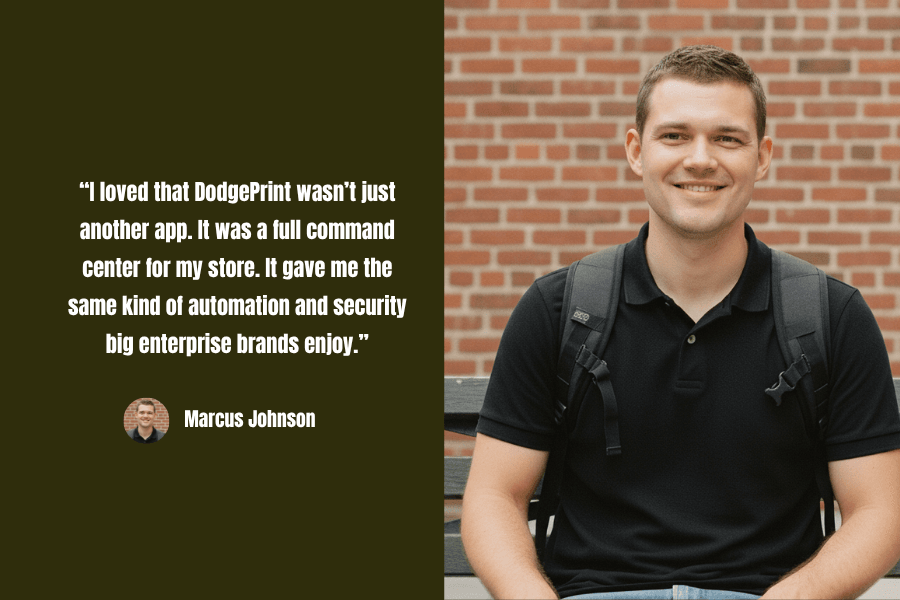
“I loved that DodgePrint wasn’t just another app. It was a full command center for my store. It gave me the same kind of automation and security big enterprise brands enjoy."
When he connected DodgePrint for the first time, the change felt almost invisible at first, but that’s what made it powerful.
It started by cleaning up what he already had.
Turning Complexity into Simplicity
His design files and mockups, which once sat in random folders, were now organized inside one library.
He could search for a product, check its variants, or update details across channels in seconds.
“It was the first time I didn’t have to wonder where something was,” Marcus explains. “Everything was just there, clean, labeled, and ready to go.”
Soon, he noticed how automation quietly took over.
New orders triggered fulfillment automatically, and each one was sent to the right supplier based on rules he set himself, cheapest, fastest, or closest to the buyer.
“Before, I had to check every order like a nervous parent,” he laughs. “Now, it’s like the system already knows what to do.”
The next improvement came with inventory sync.
Overselling had always been a nightmare, it made him refund orders, lose time, and disappoint buyers.
Now, every product update, price change, and tracking status reflected instantly across his stores.
“It’s the kind of thing you don’t notice when it works,” Marcus says. “But when it didn’t work before, it cost me hundreds every week.”
Finally, what impressed him most was how everything connected, Shopify, Etsy, Printify, even smaller POD providers, all in one workflow.
No more emailing files or copying order IDs.
“It felt like all the small tasks that used to eat my time just disappeared,” Marcus says. “The system didn’t make me feel like a big company, it made me feel organized.”
By the end of his first month, the results were clear: fewer mistakes, faster fulfillment, and hours of time saved every day.
His small team didn’t need to grow, they just needed to use fewer tools, and smarter ones.
Results: Efficiency Meets Growth
Marcus didn’t expect miracles; he only wanted calm.
But a few weeks after switching to DodgePrint, the calm turned into real progress.
He could finally see how the whole business moved, not through scattered numbers, but through patterns that made sense.
When orders spiked, he didn’t panic. The system handled routing and updates while he looked at strategy.
“I used to wake up to chaos,” he says. “Now, I wake up, open my dashboard, and everything already makes sense.”
His small team of three stayed the same, but their output doubled.
Instead of hiring more people, Marcus focused on building smarter workflows.
Every process, from design upload to delivery, now had a rhythm.
And the numbers followed.
Costs went down, margins went up, and mistakes almost disappeared.
Customers noticed too; delivery reviews improved, and repeat buyers became a larger part of his sales.
“The funny thing is,” he laughs, “nothing ‘looked’ different from the outside. Same products, same brand, but behind the scenes, it felt like night and day.”
What It Really Takes to Scale
Looking back, Marcus says his biggest win wasn’t automation, it was clarity.
He finally saw which parts of the business truly moved the needle, and which ones just looked busy.
“I learned that scale doesn’t come from doing more,” he says. “It comes from removing what doesn’t matter.”
He stopped measuring growth by headcount or hours worked.
Now, growth meant efficiency, doing the same with less effort, less noise, and more focus.
Marcus also realized that being an independent seller doesn’t mean doing everything alone.
It means choosing the right systems that help you stay small in structure but big in impact.
“When people ask how I run like an enterprise,” Marcus laughs, “I tell them, I don’t. I just stopped working like chaos was normal.”
His story reminds every creative entrepreneur that automation isn’t the enemy of creativity, it’s the foundation that lets creativity breathe.
Behind every calm, organized dashboard, there’s more space for imagination to grow.
Why Marcus Trusts DodgePrint
- Automated enterprise-grade
- Bank-level security
- Real-time data insights
- 24/7 expert support
It didn’t make his company bigger, it made it better.
Discover DodgePrint today